Made by aafereen :)

Made by aafereen :)

Made by aafereen :)

arul Health

Role

Timeline

Client

Tools

Lead UI Designer

1 - 2 months

arul Health

Figma, Procreate, Maze, Optimal Workshop

Mobile App | UX/UI Design Lead | 2025

Designing a digital space for the emotional experience of cancer.

Onboarding · Meditation · AI Companion · Reflection · Profile

Challenge

Solution

Cancer affects far more than the period between diagnosis and treatment. People with an active diagnosis, survivors adjusting to life after remission, and caregivers supporting someone through illness can all face significant emotional strain, yet mental health resources tailored specifically to these experiences remain limited. Support can become especially fragmented after treatment ends, when survivors are often expected to return to normal despite the lasting emotional impact of what they have experienced.


Arul Health set out to address this gap by creating a mental wellness experience that could support people across the broader cancer journey. The challenge was designing one platform flexible enough to respond to active treatment, caregiving and survivorship without making the experience feel clinical, generic, or overwhelming.

Arul Health creates a dedicated space for mental wellness throughout the cancer experience, supporting people with an active diagnosis, survivors, and caregivers within one adaptable platform. Personalized onboarding establishes each user's relationship to cancer and relevant context, allowing the experience to respond to where they are in their journey rather than assuming a single patient experience.


Guided meditations, daily reflection, personalized content, and an AI companion provide different forms of support depending on what a user needs in the moment. Saved practices and reflection history create continuity over time, while progress features encourage users to develop supportive routines without turning wellness into another obligation.


Rather than treating emotional support as something that ends when treatment does, Arul is designed to remain relevant as a user's relationship with cancer changes

One of the first design considerations was accounting for the different experiences users bring into the platform.

A person's relationship to cancer shapes the kind of support they may need. Arul's onboarding experience distinguishes between users navigating an active diagnosis, survivorship, and caregiving, then gathers relevant information to create a more personalized starting point.
Rather than treating every user as a patient or requiring the same information from everyone, the experience adapts to the context they provide. This allows Arul to understand enough about each user to make the platform relevant while keeping onboarding focused and approachable.

The core experience needed to make different forms of mental wellness support easy to access without adding complexity.

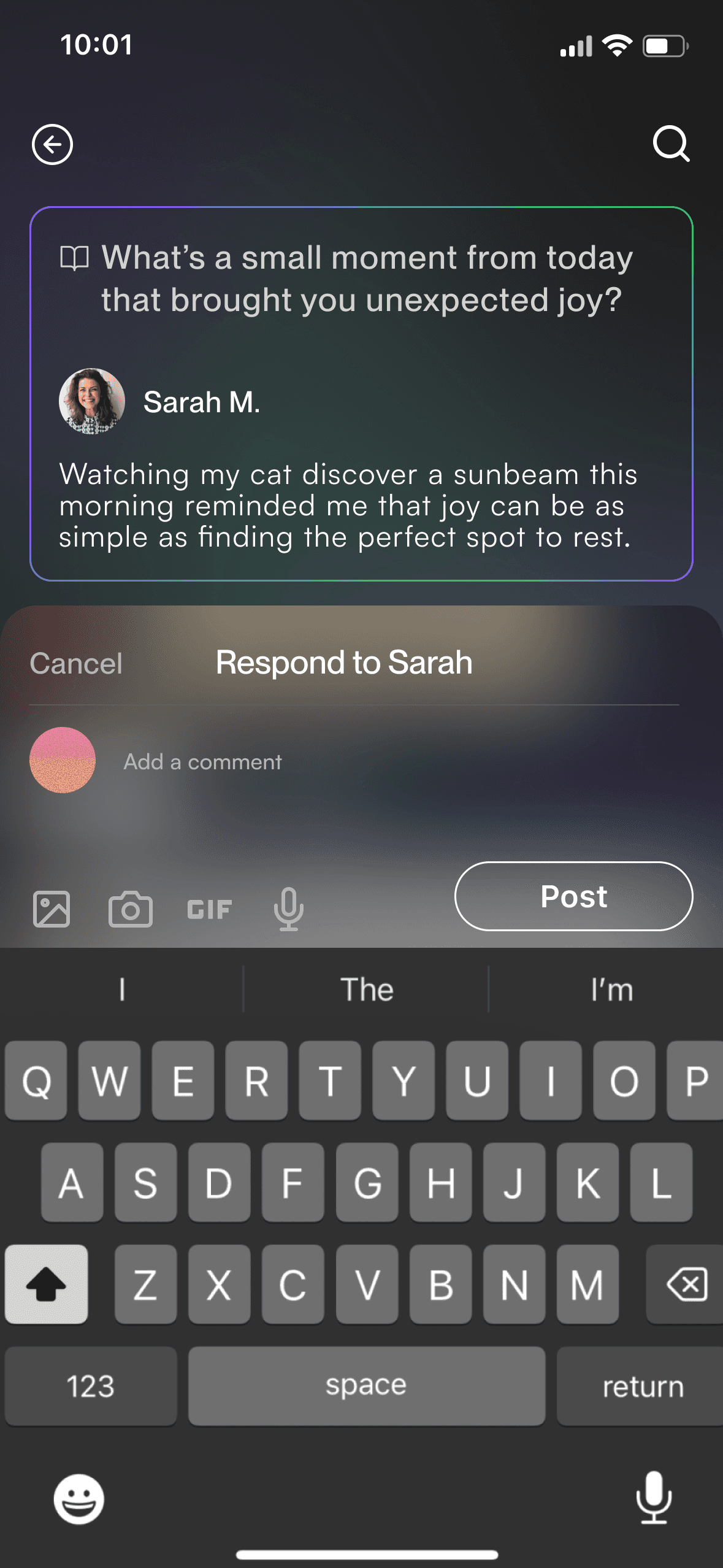
I designed the experience around two primary forms of engagement: guided meditation and daily reflection. Meditation provides a more structured activity, with discovery and saved content making it easier for users to find and return to relevant practices. The Daily Prompt Wall offers a lighter, more open-ended way to engage through short reflections that can be revisited through a calendar archive.


Designing these experiences within the same system allowed users to move between different forms of support without requiring separate workflows or introducing unnecessary navigation.

Arul’s AI companion gives users a more conversational way to engage with support throughout the platform.

Arul's AI companion provides ongoing support through check-ins, mood tracking, personalized resources, and direct messaging. During setup, users are introduced to how the companion works and can customize how they interact with it.


Designing the companion also required defining how it would behave visually throughout the product. I developed a system around five distinct states—calm/neutral, optimistic/encouraging, anxious/alert, reflective, and inactive/neutral, and established the logic for how the transitions dynamically between them.

The profile became a space for users to see their progress and return to what matters to them.

I designed the profile to bring together the parts of the experience that build over time. Users can return to saved meditations, view their meditation activity, and track progress through streaks, milestones, and badges.

These engagement features were designed to encourage consistency while keeping progress visible and rewarding. The profile also serves as a central place for managing personal information, companion preferences, clinical details, and membership settings, bringing ongoing activity and account management into a single experience.

The visual direction was designed to sit between two common approaches to mental health products: soft, overly cheerful wellness branding and more clinical, technology-driven interfaces. We wanted Arul to acknowledge the seriousness of mental health without feeling sterile or impersonal.

I used a darker foundation with atmospheric gradients and brighter accents to create a more contemporary, immersive experience, while softer typography, rounded elements, and organic forms maintain a sense of warmth and approachability. The result is a visual system that feels distinct within the mental wellness space while still supporting the sensitive nature of the product.

The visual direction was designed to sit between two common approaches to mental health products: soft, overly cheerful wellness branding and more clinical, technology-driven interfaces. We wanted Arul to acknowledge the seriousness of mental health without feeling sterile or impersonal.

I used a darker foundation with atmospheric gradients and brighter accents to create a more contemporary, immersive experience, while softer typography, rounded elements, and organic forms maintain a sense of warmth and approachability. The result is a visual system that feels distinct within the mental wellness space while still supporting the sensitive nature of the product.

I also designed the Arul mark to bring the product's purpose into the identity itself. The symbol combines three forms: a lowercase a, a person, and the loop of a cancer awareness ribbon, into a single mark, connecting the Arul name with the people and experiences the platform was created to support.

I also designed the Arul mark to bring the product's purpose into the identity itself. The symbol combines three forms: a lowercase a, a person, and the loop of a cancer awareness ribbon, into a single mark, connecting the Arul name with the people and experiences the platform was created to support.

Arul Health challenged me to think beyond individual features and consider how visual design, interaction, and product logic work together within a sensitive healthcare experience. From establishing the visual identity to designing core wellness tools and defining the behavior of the AI companion, my work focused on creating a cohesive system that could support different needs across the cancer journey.

The final product brings these elements together into an experience that feels approachable and human while still treating mental wellness with the seriousness it deserves.

Conclusion

Arul Health challenged me to think beyond individual features and consider how visual design, interaction, and product logic work together within a sensitive healthcare experience. From establishing the visual identity to designing core wellness tools and defining the behavior of the AI companion, my work focused on creating a cohesive system that could support different needs across the cancer journey.

The final product brings these elements together into an experience that feels approachable and human while still treating mental wellness with the seriousness it deserves.

Conclusion